
Using AI responsibly
12 June 2026
Learning Pathway:
AI Aware 101
Learn the S.A.F.E. AI habits for everyday work.

AI can help you work faster. It can also create new risks.
AI can draft emails and analyse information in seconds. But using it responsibly means understanding both its strengths and its limitations.
AI can sound confident even when it's wrong.
AI does not take responsibility for its outputs.
Not all AI tools are safe for sensitive information.
That's why responsible AI use matters. A simple way to remember the key principles is the S.A.F.E. framework.
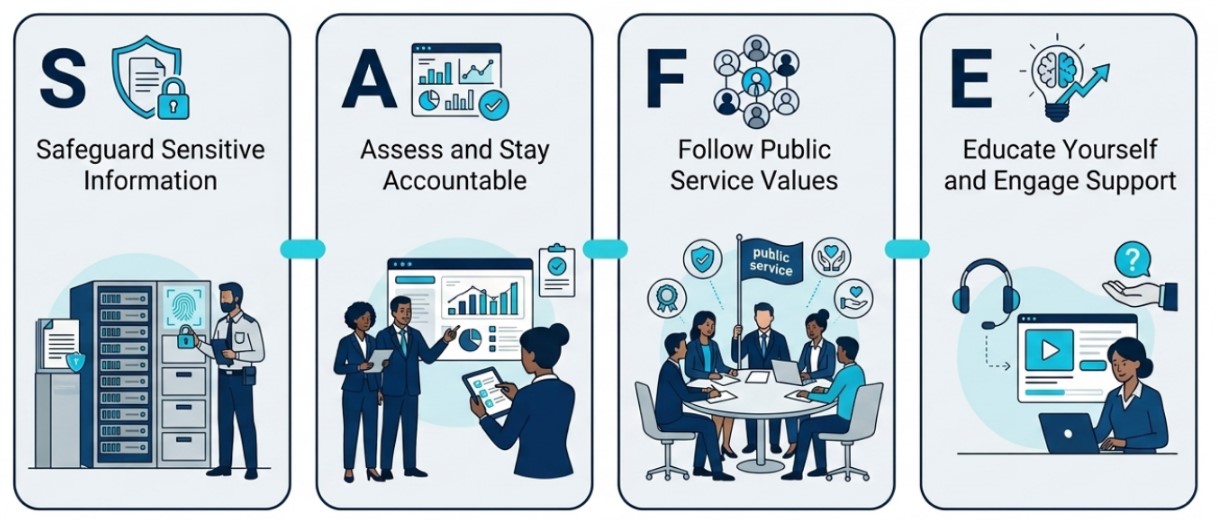
S — Safeguard sensitive information
Before using any AI tool, ask yourself: What information am I about to share?
Not all AI tools have the same security controls. Some tools are designed to handle sensitive organisational information, others are not.
Here is a Data Classification and Sensitivity guide for some of the AI tools you might access:
Classification and Sensitivity | WOG Enterprise AI tools (ChatGPT, Copilot, Gemini (opens in new tab)) | Government AI tools (Pair (opens in new tab), AIBots (opens in new tab)) | Public AI tools |
Confidential / Sensitive (High) & above | No | ||
Confidential (Cloud-Eligible) / Sensitive (Normal) | Yes | No | |
Restricted / Sensitive (Normal) | Yes | Yes | No |
Official (Open/Closed) / Non-Sensitive | Yes | Yes | Yes |
Quick check
Before submitting a prompt, ask:
Does this contain personal or sensitive information?
What is the data classification allowed for this AI tool?
A — Assess and stay accountable
AI can help produce outputs. It cannot take responsibility for them. You remain accountable for:
Accuracy
Fairness
Appropriateness
Compliance
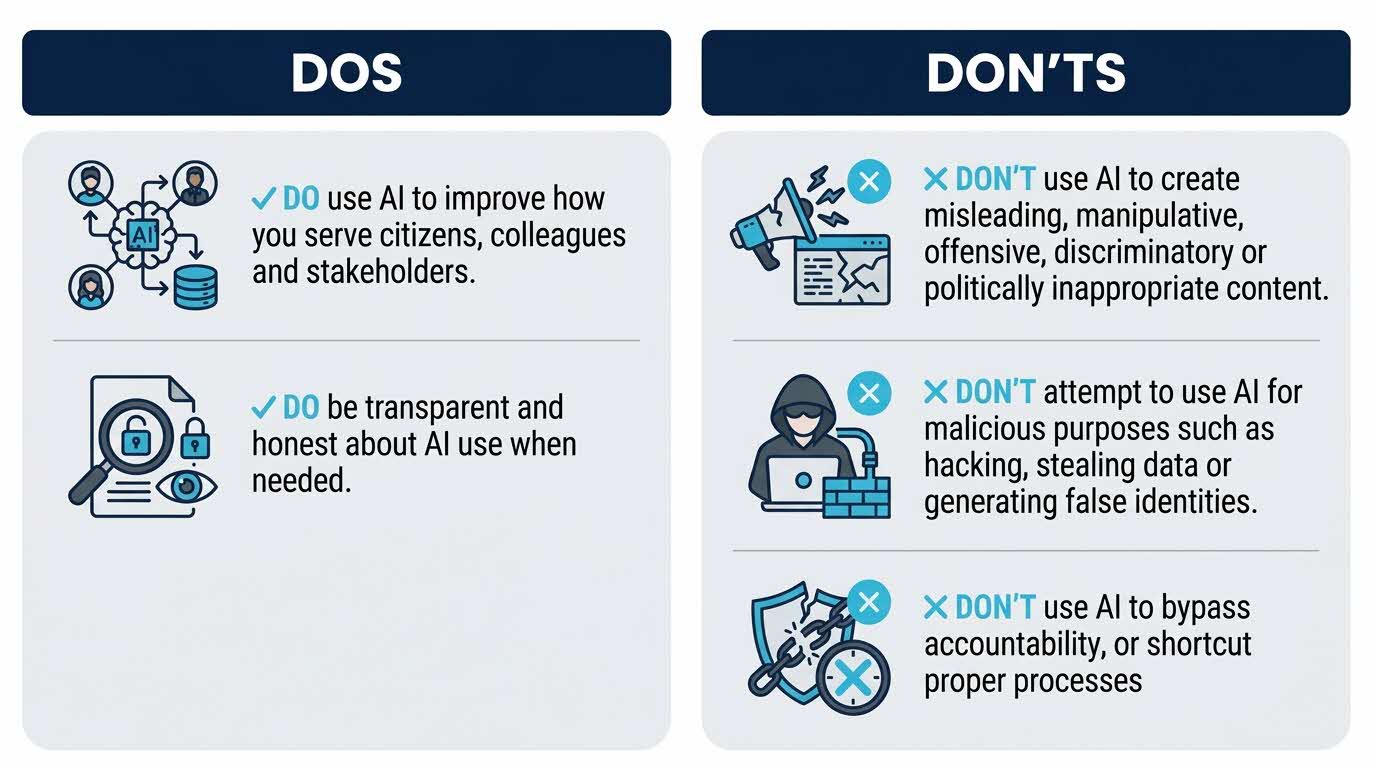
Here are some Dos and Don'ts when using AI in your work:
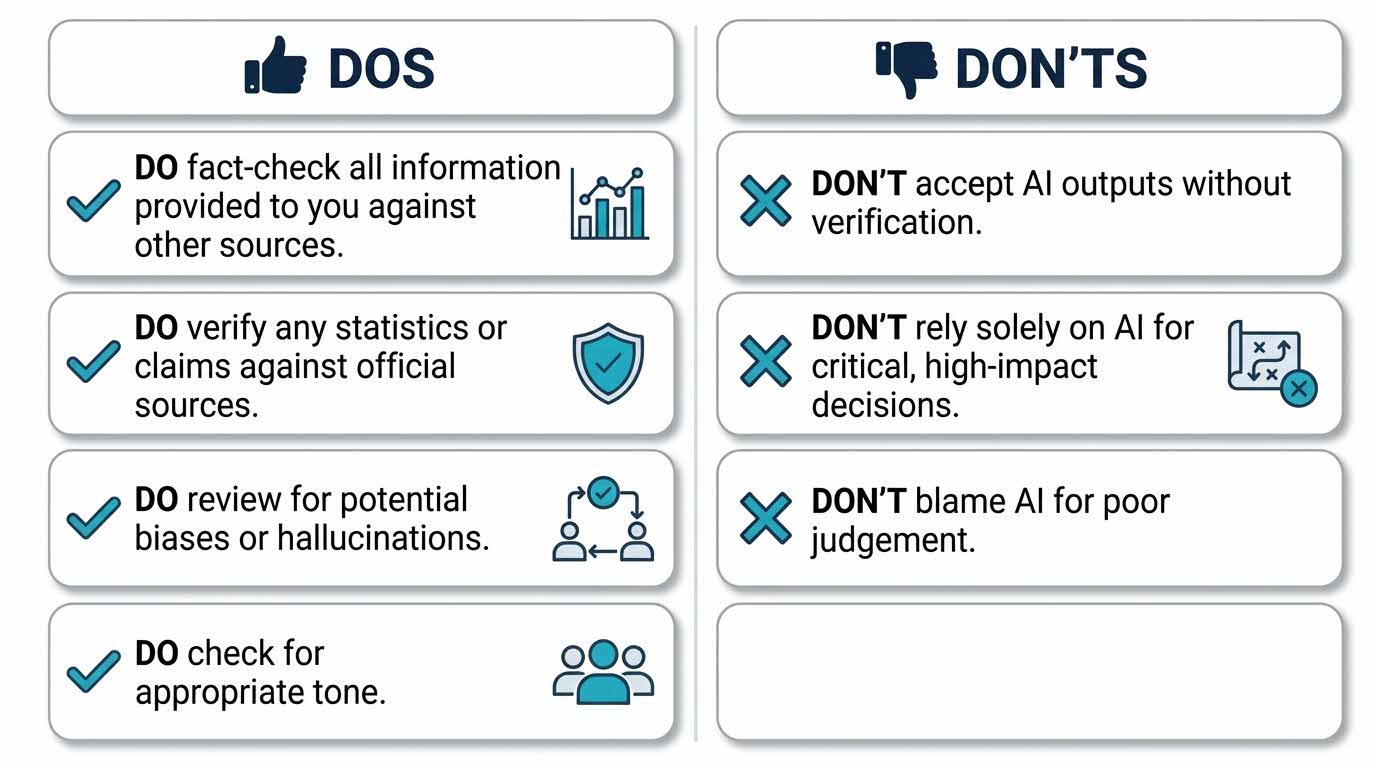
Think of AI as a first draft
A useful approach is to treat AI outputs as a starting point rather than a finished product.
Review the output
Verify important facts
Check calculations
Assess whether the content makes sense in your context
The question is not "Did the AI generate this?" The question is "Would I be comfortable standing behind this output?" If the answer is no, further review is needed.
F — Follow public service values
Technology does not change our values. The same values that guide our work should guide our use of AI. This includes acting with:
Integrity
Service
Excellence
AI may be a new technology, but the standards expected of public officers remain unchanged.
E — Educate yourself and engage support
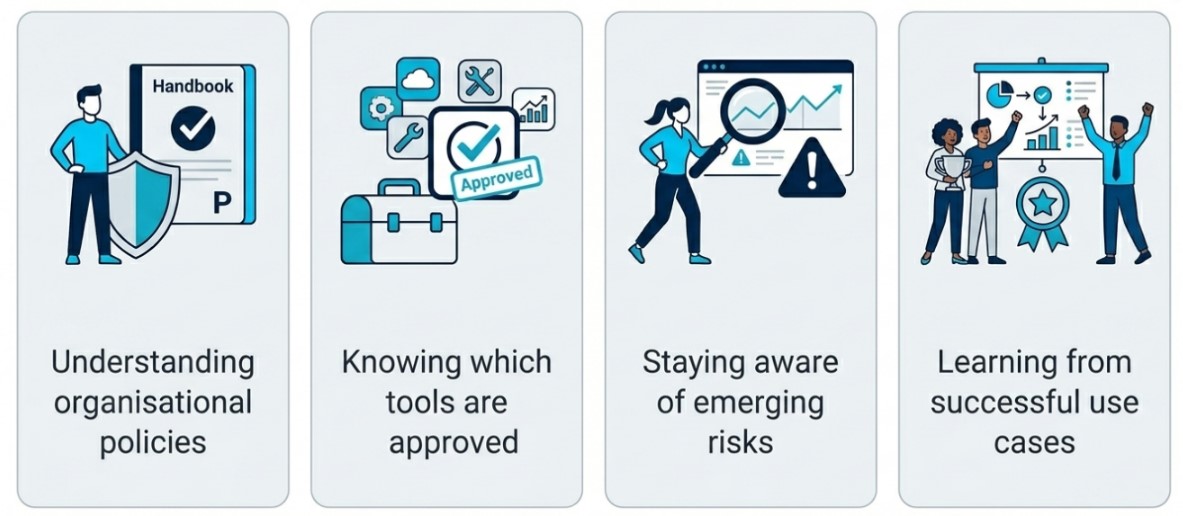
AI is evolving rapidly. New tools, capabilities and guidance emerge regularly.
Responsible use requires continuous learning. This does not mean becoming an AI expert. It means staying informed enough to use these tools appropriately.
Examples include:
Common situations and how S.A.F.E. applies
Drafting an email with AI
Remove unnecessary personal information.
Review the output before sending.
Ensure the tone is appropriate.
Drafting a report with AI
Verify important facts.
Check whether conclusions are supported by sources.
Exploring a new AI tool
Check what data classification the tool is approved for.
Understand the sensitivity of the material you provide to the tool.
Analysing survey results with AI
Review the AI's interpretation.
Check for potential biases.
Validate key findings before sharing them.
What this means for you
AI can be a valuable assistant, but humans remain responsible.
The SAFE framework provides a practical way to balance productivity with accountability.
Use AI to support your work. Apply judgement to validate the outcome. That combination is where the greatest value is created.