Product Thinking: Assumptions and Risks
19 May 2026
Learning Pathway:
AI Build 301
Learn to surface, stress-test, and de-risk assumptions early.

Types of Risk
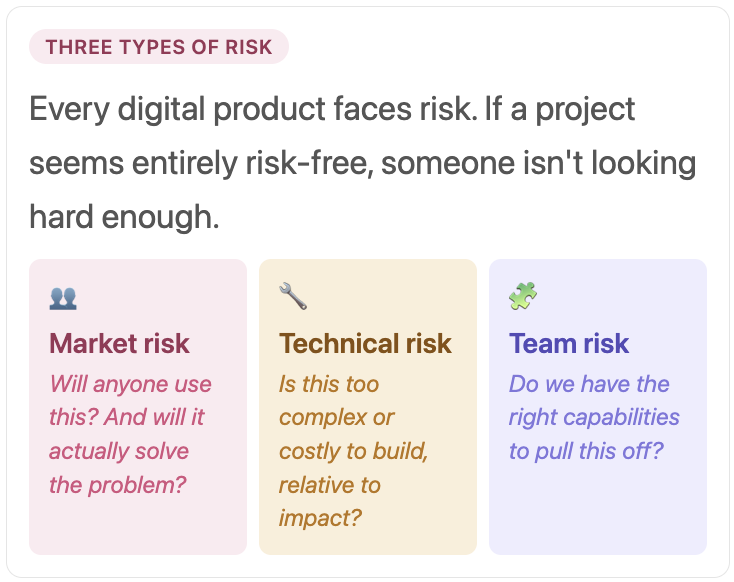
We have a problem statement and metrics. Before we build anything, we need to ask: what could go wrong, and what's the cheapest way to find out? Let's look at three common types of risk digital products can face.
Four Stages of De-risking
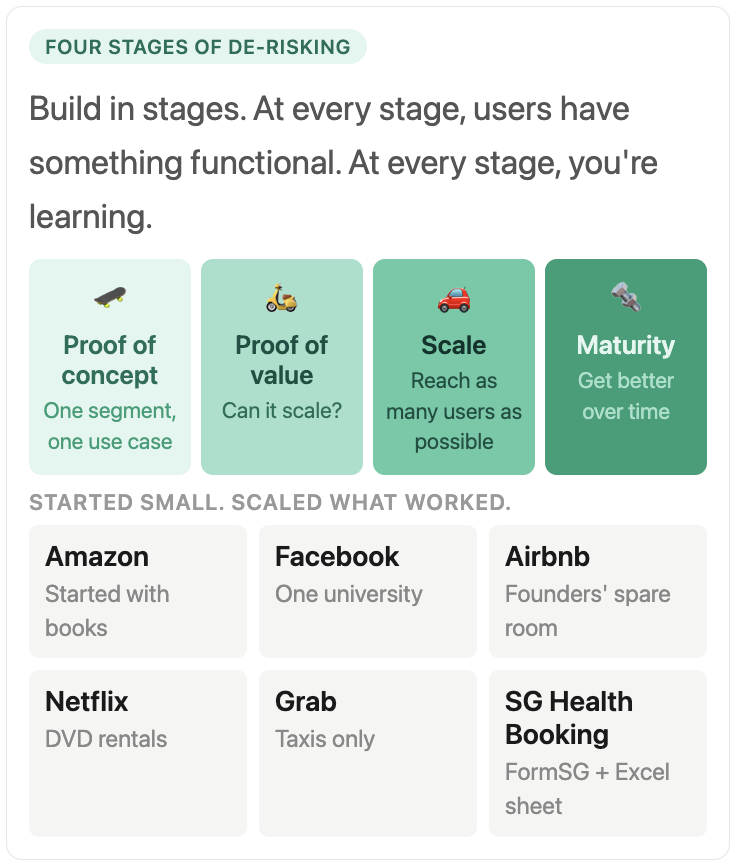
One practical way to de-risk is to build and test in stages: proof of concept, proof of value, scale and maturity.
De-risking Strategies
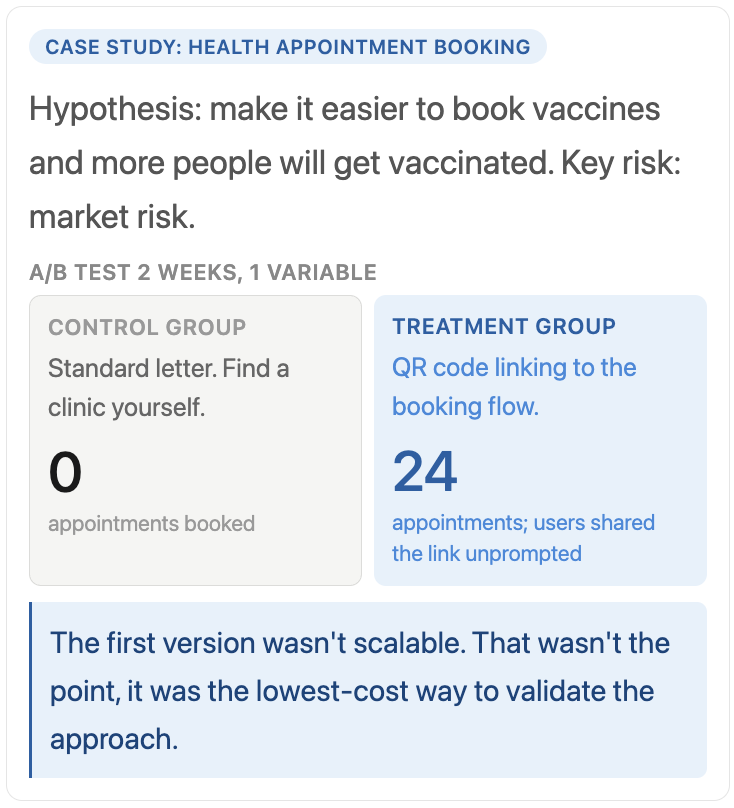
To address market risk: get your product in front of real users as early as possible.
The Singapore health appointment booking system started as a FormSG form feeding into an Excel sheet. This is not scalable, but it was the lowest-cost way to validate the approach. An A/B test showed zero bookings from the control group versus 24 from the treatment group, with users sharing the link unprompted. One variable. Clear result.
To address technical risk: start small. A proof of concept doesn't need to be scalable, it just needs to be testable. The goal is to find out whether the solution works before committing to building it properly.
To address team risk: structure for speed, focus, and flexibility, with policy, ops, and tech expertise in one room, and clear accountability for every role.