
Beyond Prompting: From Chatbot to Assistant to Agent
1 January 2026
Learn how AI can support work at different levels
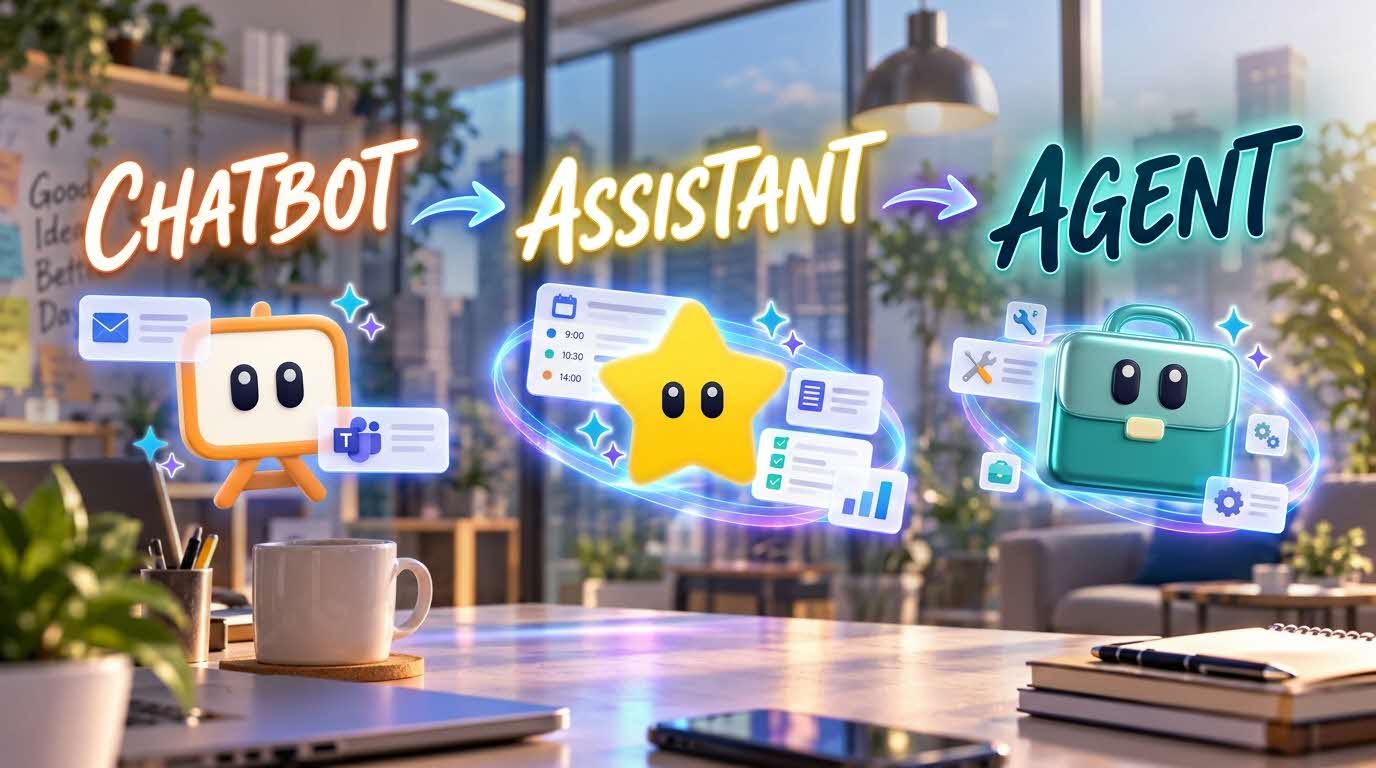
AI can do more than answer a prompt
You may already use AI for simple, one-off tasks, such as summarising documents. But what if you need AI to do more than produce a quick answer?
As your task becomes more complex, the way AI supports you can change too. The key differences are:
how much context the AI uses
how many steps it can support
how independently it can work
From chatbot to assistant to agent
You can think about AI in three levels of increasing autonomy and complexity:
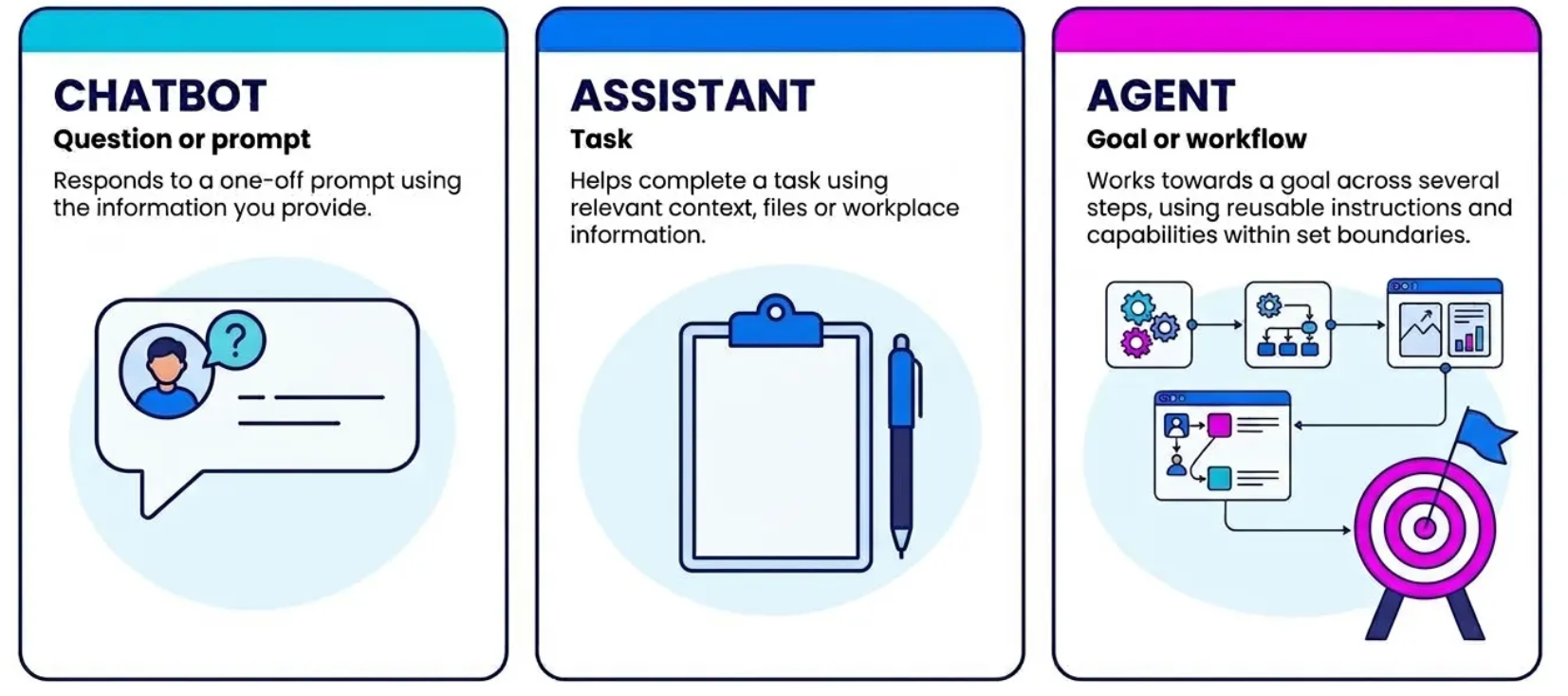
Let's apply each level to the example of [analysing survey comments].
1. Chatbots answers questions
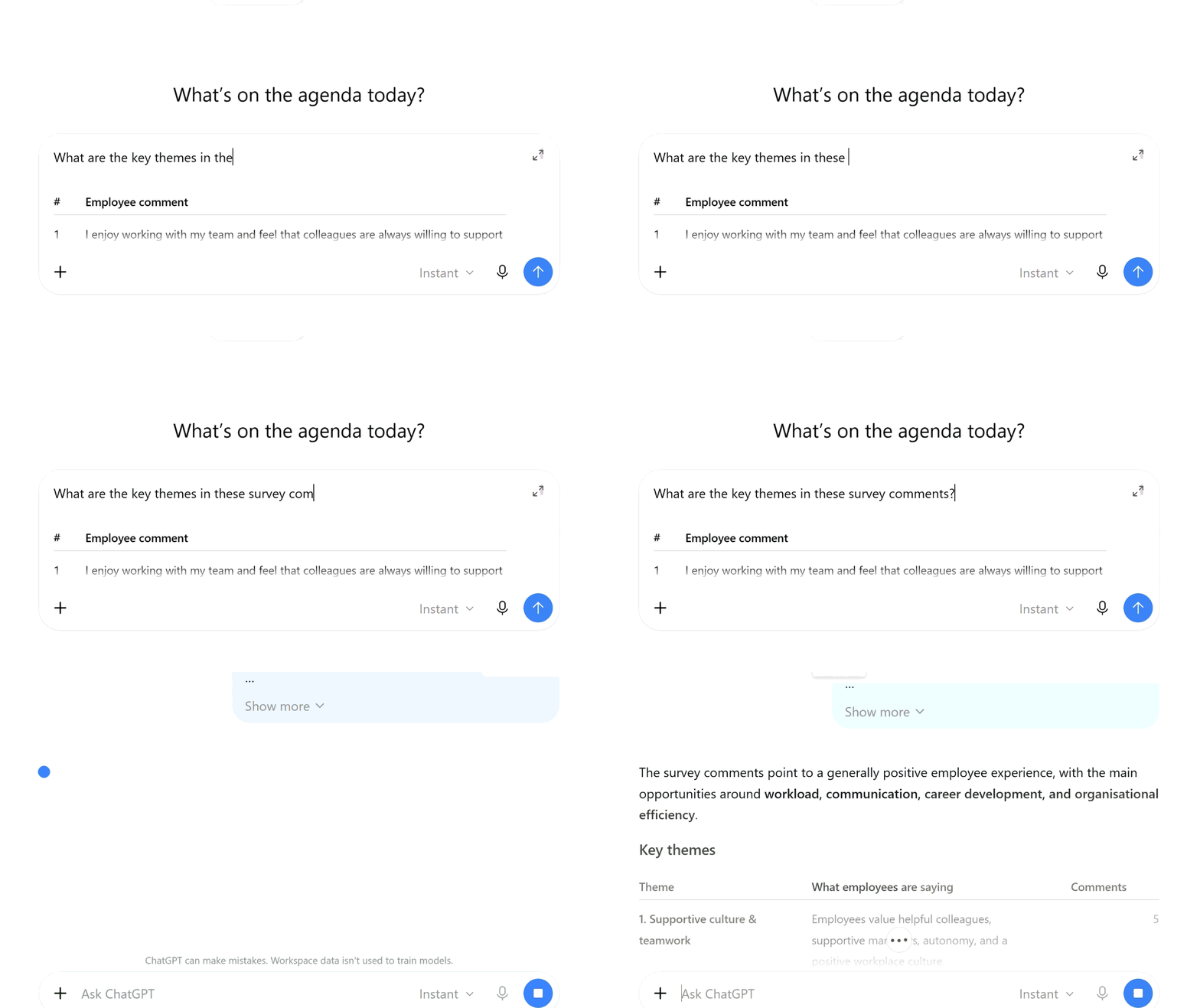
We can paste our survey data in the chat, and ask AI to analyse them.
💡The chatbot: | Responds to a question or one-off prompt using the information you provide |
✅ Best for: | One-off questions, brainstorming, first drafts, rewriting and summarising |
🙋♂️ Your role: | Direct each interaction and decide what happens next |
2. Assistants helps with tasks
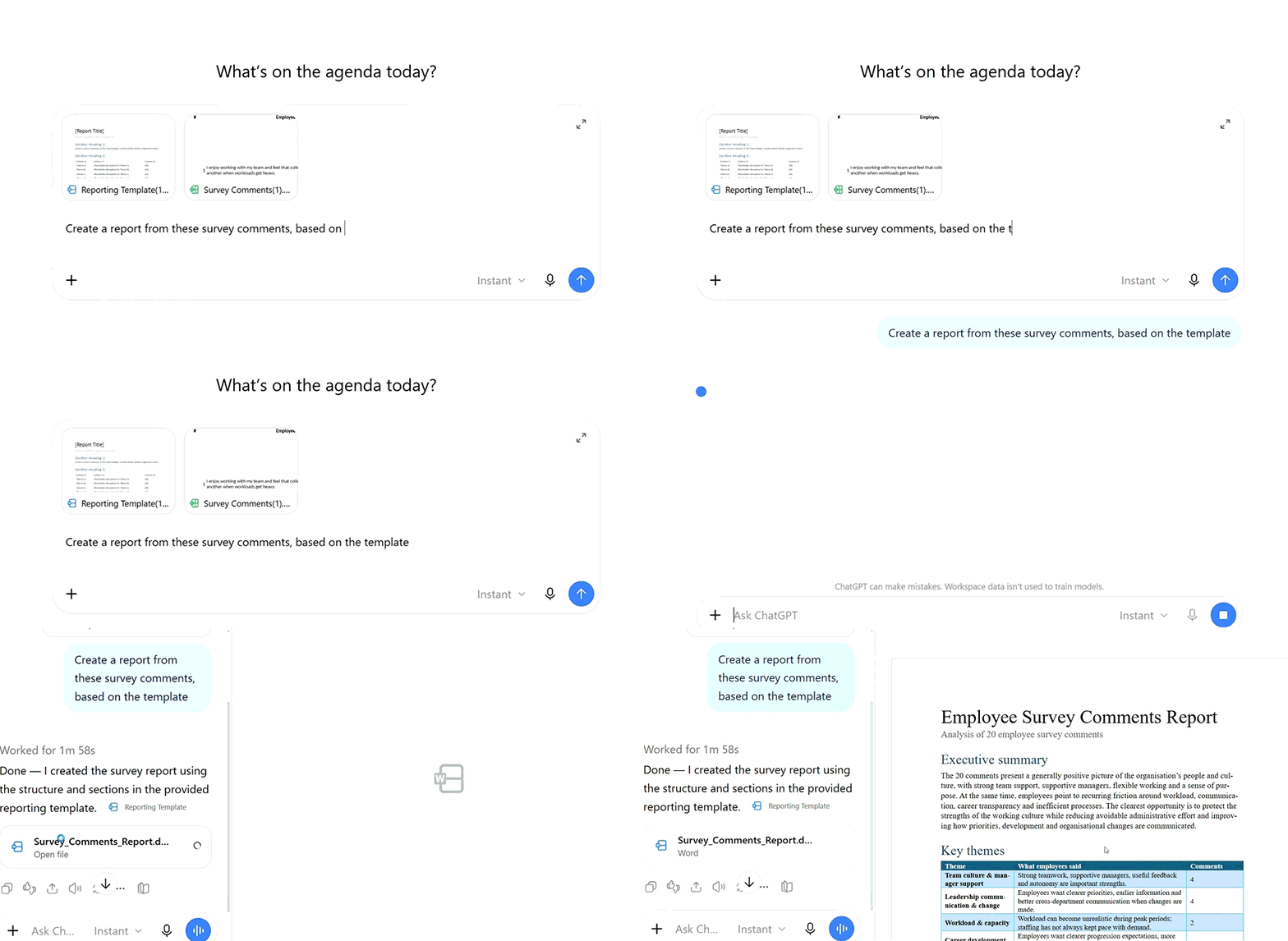
We can also upload the survey data and reporting template, and ask AI to generate the report.
💡 The assistant: | Helps complete a task using relevant context, files or workplace information. |
✅ Best for: | Comparing documents, analysing information and preparing reports. |
🙋♂️ Your role: | Provide context, guide the work and review the output. |
3. Agents work towards a goal
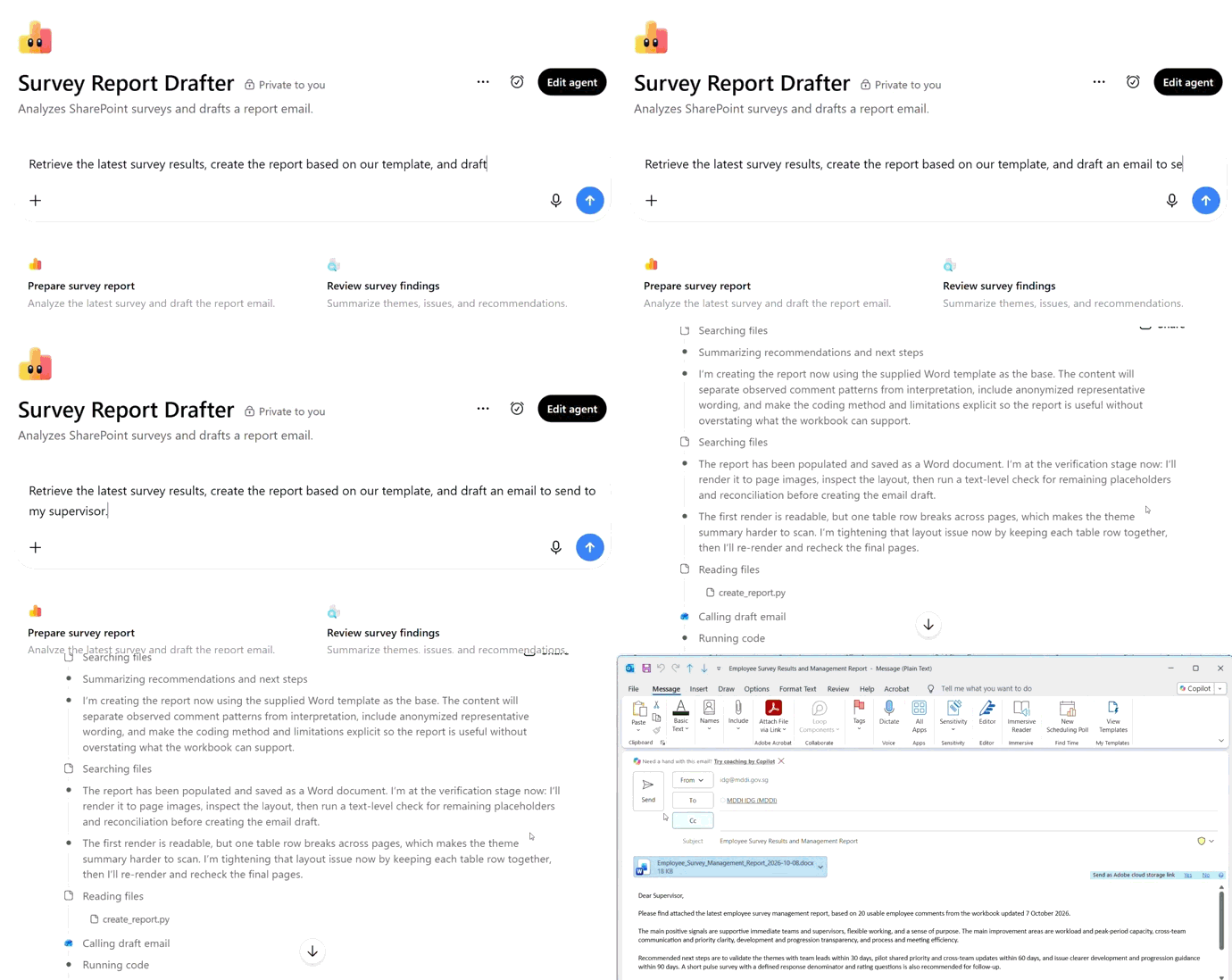
Finally, we can create an Agent that goes from retrieving the latest survey results, to generating a ready-to-send reporting email.
💡 The agent: | Works towards a defined goal across several steps, using reusable instructions and approved capabilities within set boundaries. |
✅ Best for: | Repeatable, multi-step work with an established method and clear review points. |
🙋♂️ Your role: | Set the goal and boundaries, monitor the work and approve important actions. |
Which should I use?
An agent may sound more advanced, but that does not mean every task needs one. Start with the simplest option that gets the job done.
Use a chatbot when… | Use an assistant when… | Use an agent when… |
|---|---|---|
The task is one-off or changes frequently. | The task requires files or workplace context. | The task happens regularly, and involves several connected steps. |
E.g. Identifying key themes from survey comments pasted into the chat. | E.g. Analyse uploaded survey results and draft a report based on the findings. | E.g. Retrieve the latest monthly survey results, analyse them using an established approach, prepare the report and draft an email for your review. |
Which level fits the task?
Decide whether a chatbot, assistant or agent is the most suitable starting point. Open the answer when you are ready.
1. You have drafted a submission and want to make it more concise.
Recommended starting point: Chatbot.
This is a focused, one-off task. Provide the paragraph, audience and desired tone, then review the rewritten version.
2. You need to compare several proposals against approved criteria and prepare an assessment.
Recommended starting point: Assistant.
The AI needs the proposals, criteria and output format. It can support the comparison and drafting, but you should examine the evidence and determine the final assessment.
3. Every month, your team retrieves the same information, applies the same analysis, prepares a standard report and drafts an email for clearance.
Recommended starting point: Agent
The task is repeated, follows an established method and requires several connected steps. You must still review the report before it is sent.
4. You are exploring an unfamiliar issue and your questions are changing as you learn more.
Recommended starting point: Chatbot or assistant.
A flexible conversation is more useful than configuring an agent before the issue, sources and required outcome are sufficiently clear.
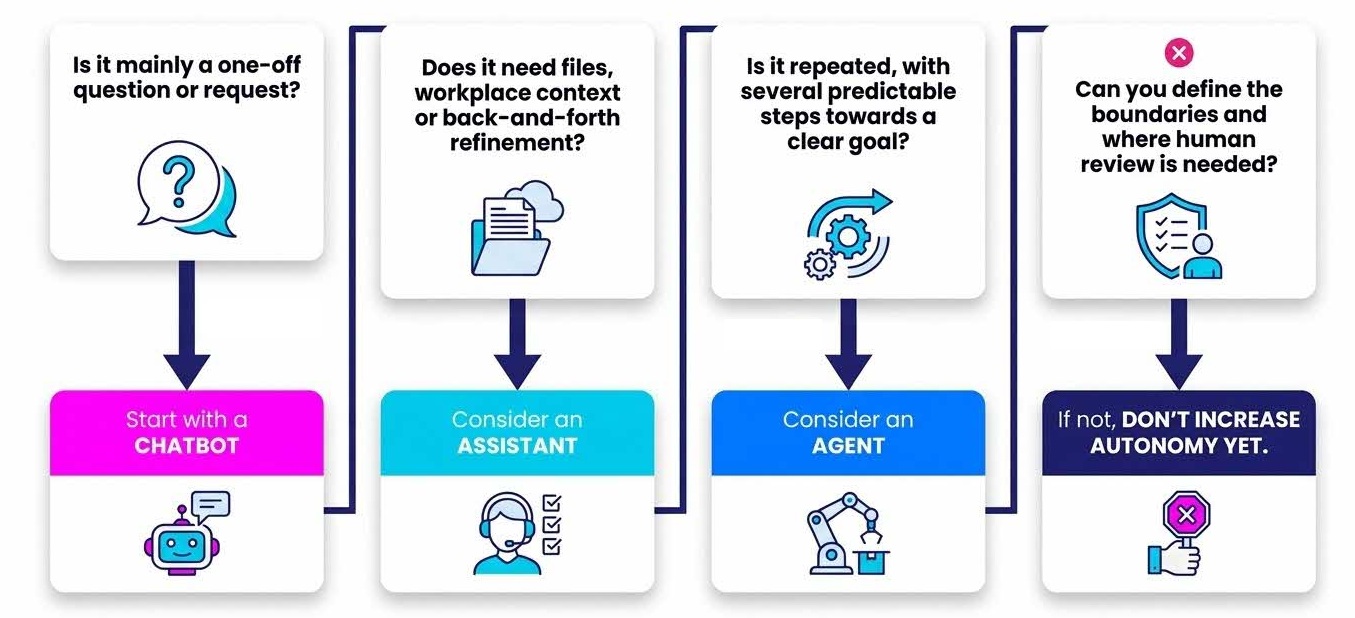
A quick way to decide
Key takeaway
Start simple.
Use a chatbot for a one-off interaction,
An assistant for context-rich task support,
An agent when repeatable work benefits from coordinated steps and controlled autonomy.